
Life on Earth did not suddenly become complex during the Cambrian explosion. New fossil discoveries from southwestern China suggest that several advanced animal forms already existed millions of years earlier. These fossils date back to the Ediacaran Period, a time just before the Cambrian era began more than 539 million years ago.
The findings offer a detailed look at organisms that lived on ancient seafloors and hint that animal evolution was already well underway long before the famous diversification event recorded in the fossil record.
Researchers studying these fossils have uncovered hundreds of specimens that reveal unexpected biological complexity. Some animals show advanced body structures linked to feeding and movement, which suggests that early animal groups had begun diversifying earlier than many scientists believed.
Life on the Seafloor Over 539 Million Years Ago
More than 539 million years ago, the ocean floor hosted an unusual community of organisms. Among them were soft-bodied animals shaped somewhat like clarinets. These creatures anchored themselves to the seabed using flat, disc-like bases. Their bodies extended upward and swayed gently in the water, alongside stalked organisms that resembled worms or delicate baskets.
These strange organisms emerged from a newly discovered collection of fossils in southwestern China. The specimens capture a snapshot of marine life that lived just before the Cambrian explosion, a moment in Earth’s history when animal diversity increased rapidly, and many modern body plans appeared.
The research team described these findings in a study published April 2 in the journal “Science.”
Paleontologist Emily Mitchell from the University of Cambridge described the work with enthusiasm, stating, “This paper is absolutely fascinating. It provides vital insights into life around the end of the Ediacaran Period.”
Understanding the Ediacaran Period
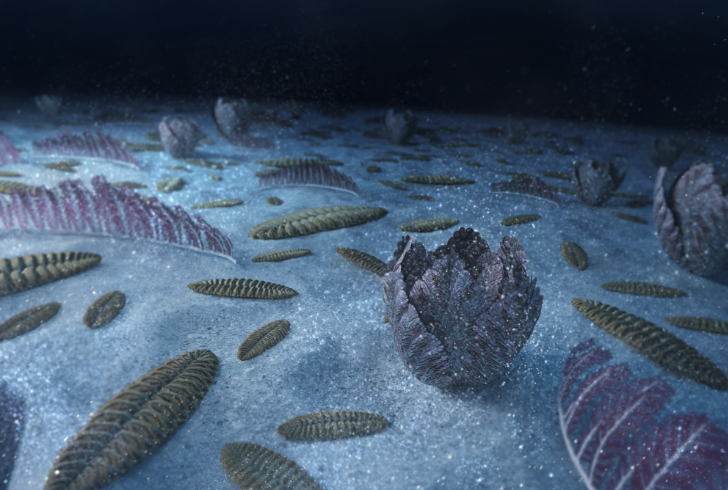
Instagram | metazoa.studio | Ediacaran Period introduced mysterious early organisms that remain difficult for science to classify.
The Ediacaran Period came just before the Cambrian explosion. It spans roughly from 575 million to 539 million years ago. Fossils from this era represent the earliest clear evidence of animals. Still, many specimens from that time reveal little about how these organisms functioned or what their bodies looked like in detail.
During the Cambrian explosion, animal forms multiplied rapidly. New body designs appeared across many groups, creating the foundation for much of the diversity seen in modern animal life. Yet the origins of that sudden expansion remain debated.
Many Cambrian animal groups do not appear clearly in Ediacaran fossils. Because of that gap, scientists once thought the Cambrian explosion may have emerged from only a small set of earlier species.
The new fossils from China challenge that assumption.
Discovery Near Jiangcheng
The discoveries began during fossil surveys near Jiangcheng in China’s Yunnan Province. In 2022, paleontologist Gaorong Li, who was working at Yunnan University in Kunming at the time, and colleagues searched the area for fossils of Ediacaran algae.
During fieldwork, the team noticed unusual fossil fragments that did not match known algae structures. These fragments raised immediate questions.
The following year brought a breakthrough.
In 2023, researchers uncovered cylindrical animal fossils preserved in the rock. These organisms would have stood several centimeters above the seafloor. Each specimen featured a flat pad at one end that likely attached to the seabed. At the opposite end, a flag-shaped proboscis extended outward from the mouth area.
These animals quickly gained the nickname “bugle worms” because their shapes resemble small wind instruments.
Li later explained that these fossils changed the direction of the investigation. “These ‘bugle worms’ were a turning point for the team,” he said.
Hundreds of Fossils Collected
The discovery drew interest from researchers at the University of Oxford. Scientists from both institutions organized a joint expedition in 2024 to examine the site more closely.
That expedition uncovered even more fossil specimens.
Across multiple field trips, the team collected about 700 fossils from the late Ediacaran deposits. Many of them showed clear anatomical features that allowed scientists to compare them with previously known organisms from both the Ediacaran and Cambrian periods.
This comparison revealed several unexpected similarities.
Evidence Linked to Early Muscle Tissue
Some fossils resemble an organism known as Haootia, first formally described in 2014. Haootia dates to roughly 560 million years ago and represents the earliest evidence of muscle tissue found in animals.
The shape of these organisms appears similar to a living martini glass. A central stalk rises upward from the seafloor and supports a ring of tentacles at the top. The structure resembles certain modern marine animals such as corals, jellyfish, and sea anemones.
These organisms share a biological trait known as radial symmetry. Their body parts radiate outward from a central point rather than forming left and right sides.
The newly discovered fossils show similar arrangements, suggesting that animals with this type of structure already lived during the Ediacaran Period.
Surprising Evidence of Bilateral Animals
Even more striking discoveries involve animals with bilateral symmetry. In these organisms, the left and right sides of the body mirror each other. Many modern animals, including humans, display this body plan.
Fossils of bilaterian animals from the Ediacaran Period remain rare. Before this study, scientists recognized only four species with bilateral symmetry from that era.
The Chinese fossil site revealed far more examples.
Researchers identified more than 180 bugle worm fossils. Alongside them appeared several other bilateral animals with unusual shapes. Some resembled sausages threaded onto skewers. Others possessed feathery appendages surrounding their mouth openings, structures that likely helped with feeding.
These features indicate that these animals were not extremely primitive.
Emmy Smith, a paleontologist at Johns Hopkins University in Baltimore, noted the significance of these discoveries. She observed that many fossils display structures tied to feeding behavior.
“These weren’t simple progenitors of later lineages; these animals were already quite physically complex,” Smith said. She added that the findings strengthen the view that major animal groups had already begun diversifying before the Cambrian explosion.
Early Deuterostomes in the Fossil Record
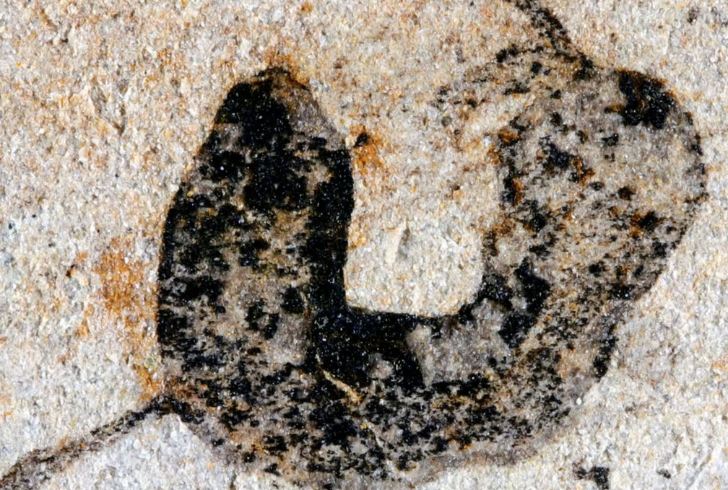
Instagram | oxuniearthsci | This early deuterostome fossil represents a common ancestor to both vertebrates and echinoderms.
One of the fossils discovered represents an early deuterostome. This group includes animals related to vertebrates and echinoderms such as sea stars.
The fossil shows appendages at one end of the body that may have helped capture food. The presence of this type of organism during the Ediacaran Period provides rare evidence of bilateral animals linked to later evolutionary groups.
Such discoveries help bridge the evolutionary gap between the Ediacaran organisms and the more recognizable animals that appear during the Cambrian.
The traditional view of the Cambrian explosion suggests that animal diversity appeared rapidly and somewhat abruptly around 539 million years ago.
The new fossils suggest a different story.
According to Li, complex animals may have been evolving gradually for millions of years before the Cambrian period began. The apparent “explosion” recorded in the fossil record may simply reflect a moment when these animals became easier to preserve or more widespread.
Instead of a sudden burst of new life forms, the Cambrian event might represent the visible outcome of earlier evolutionary progress.
What Comes Next
Scientists now aim to determine how these Ediacaran animals connect to the organisms that appear later in the Cambrian fossil record.
Scott Evans, an invertebrate paleontologist at the American Museum of Natural History in New York City, believes this research could reveal how familiar Cambrian animals first developed.
He noted that identifying evolutionary relationships between these groups could explain where later animal lineages originated and how they expanded.
Fossils discovered in southwestern China provide new insight into early animal evolution. Nearly 700 specimens show that complex organisms with features such as radial and bilateral symmetry already lived during the late Ediacaran Period, before the Cambrian explosion.
The evidence indicates that animal diversity began developing millions of years earlier than previously assumed. Ongoing research may reveal how these early organisms connect to the animal groups that later became widespread during the Cambrian era.