
Chemists have synthesized a molecule with an extraordinary twist, surpassing even the classic Möbius strip. Unlike the familiar Möbius, which loops back on itself after a full turn, this new molecular form demands multiple circuits to return to the starting point. Its structure challenges long-held assumptions about how atoms can bond and form shapes.
Igor Rončević from the University of Manchester explains, “This molecule defies expectations. It isn’t only the unusual form that fascinates; it proves that such a structure can exist.”
This discovery opens the door for designing molecules with unprecedented three-dimensional topologies.
Crafting the Twist
To assemble this molecule, researchers arranged 13 carbon atoms and two chlorine atoms into a compact ring. They performed the synthesis on an ultra-cold gold surface to maintain stability.
Two advanced instruments, a scanning tunneling microscope and an atomic force microscope, allowed precise control over the atomic layout. These tools also mapped the movement of electrons, revealing the molecule’s unique behavior.
Unlike standard molecules, electrons in this structure aren’t confined to a single atom. They flow across regions like ripples in a pond. These electron patterns created the molecule’s exceptional Möbius-style twist.
A microscopic traveler would need four loops along the ring to return to its original location, illustrating how extraordinary this shape truly is.
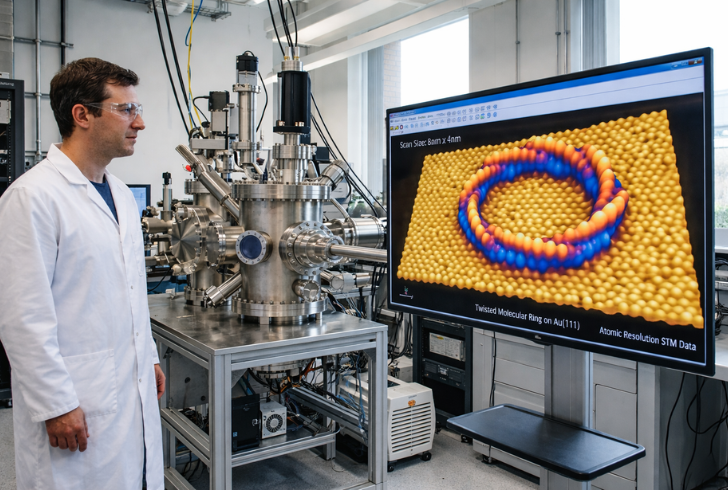
Gemini AI | Scientists forged a compact ring of $13$ carbon and $2$ chlorine atoms atop a frigid gold surface.
Manipulating Molecular Geometry
Scientists have demonstrated that a tiny electromagnetic pulse can adjust the twist of a molecule. The molecule can shift from left-handed to right-handed, or even untwist completely. This control allows chemists to explore molecular topologies in ways that were previously theoretical.
To understand why the molecule adopts this twist, the team relied on simulations using both conventional computers and IBM’s quantum processors. Quantum computers excel at modeling the interactions between electrons—the key drivers behind the molecule’s twisting behavior.
Rončević points out that quantum systems offer far higher accuracy for predicting complex electron dynamics than traditional computational methods.
Expert Perspectives on the Discovery

Freepik AI | Precision tools and quantum computing are transforming complex molecular designs from theory to practice.
Ivano Tavernelli from IBM notes, “Quantum computing already proves invaluable for tackling real-world chemical problems.”
Gemma Solomon at the University of Copenhagen describes the experiment as “a landmark achievement spanning nanoscience, organic chemistry, and surface science.”
Kenichiro Itami of RIKEN calls the study “a technical marvel that vividly brings abstract topological ideas into molecular chemistry.”
Dongho Kim from Yonsei University highlights the molecule’s ability to switch forms as particularly promising. “This feature could enable molecules to act as sensors or respond predictably to magnetic fields,” Kim explains.
These insights point toward new possibilities for designing responsive molecular devices.
Expanding the Horizon of Chemistry
This discovery marks a significant step in molecular engineering, demonstrating that complex twists and topologies are no longer just theoretical concepts. By merging precision instruments with quantum computation, chemists can now investigate novel shapes, behaviors, and functions.
The molecule’s flexible twist offers a glimpse of shape-shifting molecular systems of the future. Its influence could extend across chemistry, materials science, and quantum technology.
Ultimately, the molecule’s intricate twist is a reminder that chemistry continues to surprise even the most experienced researchers. Controlled topologies transform atoms from passive components into building blocks for entirely new designs.
As technology advances, molecules like this one could transform the way materials and devices are developed.